A local photograph can make a thoughtful gift because it begins with something shared. The place may belong to the recipient’s everyday life, an earlier chapter or a memory you have together. The challenge is to choose an image that reflects that connection without assuming that your favourite view is also theirs.
Start with the person, then work towards the picture. Think about where they spend time, which parts of Bearsted or Thurnham they mention, and what kind of images already have a place in their home. These observations are more helpful than trying to identify a universally popular local scene. A gift feels personal when the choice has a reason, even if that reason would not be obvious to anyone else.
Choose the connection before the landmark
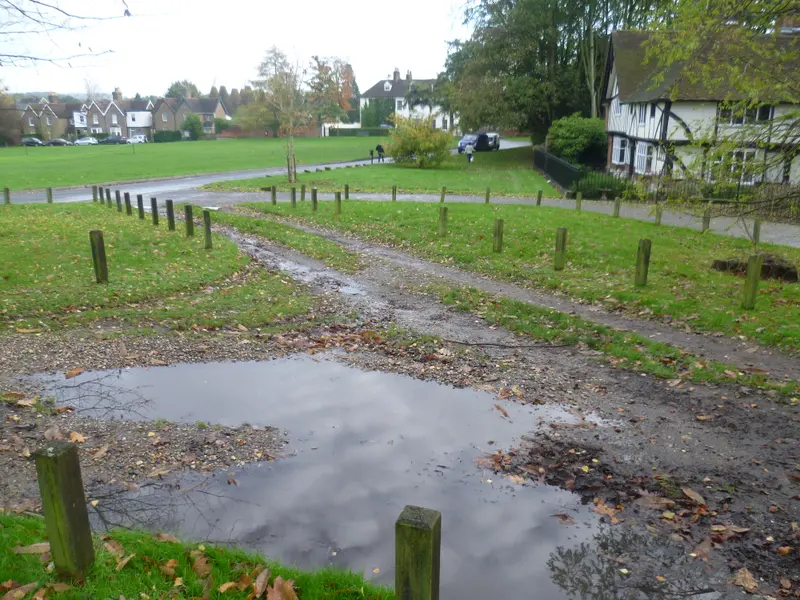
The best-known view is not always the most meaningful one. Someone may be attached to a quieter path, a woodland detail or the shape of the open landscape. Another person may respond strongly to the Green because it connects several memories at once. The important distinction is between choosing a place because it is recognisable and choosing it because it matters to the recipient.
Make a short list of possible connections. You might think of a route, a former home, a meeting place or a regular visit. Then look for photographs that express those connections honestly. Avoid inventing a story around an image simply because it is attractive. The title and caption should support what the picture actually shows.
If the right subject is not in the collection, that is useful information to include in an enquiry. It is better to ask whether an appropriate photograph is planned than to settle for a different location presented as if it were the one you had in mind. A personal gift benefits from accurate details.
Notice how they live with pictures
You do not need to analyse an entire interior to choose thoughtfully. A few observations can help: do they have small pictures in groups, or larger works with more space around them? Are the frames mostly light, dark or wooden? Do they prefer detailed scenes or simpler compositions? These are clues, not rules that prevent you from choosing something new.
Consider the likely setting as well as the image. A recipient who moves frequently may appreciate a size that can fit several spaces. Someone with a particular empty wall may have a clearer scale in mind. If you do not know the available dimensions, acknowledge that uncertainty instead of guessing with confidence.
A photograph can also be meaningful without matching the room perfectly. The goal is to avoid obvious practical difficulties, such as a frame too large for any plausible space. An attractive image in a considered, manageable format often offers more flexibility than a very large statement chosen without measurements.
Decide what should be a surprise
A gift does not have to conceal every decision. You might choose the photograph together and keep the presentation as the surprise, or select the image while asking a simple question about frame colour. This can be particularly helpful when the recipient has strong preferences or an existing arrangement of pictures.
If you want the whole choice to remain private, use what you genuinely know rather than assumptions about what someone of a particular age or background ought to like. Local connection and visual taste are personal. The same woodland picture might appeal to a long-term resident, a new neighbour or a visitor for entirely different reasons.
Think about the words that could accompany the gift. A short explanation of why you chose the place may be more meaningful than a generic statement about the quality of the artwork. Keep that explanation separate from factual claims about the photograph. Your memory belongs to you; the image’s provenance should still be accurate.
Use the outer size when planning
For a framed gift, the outer dimensions determine whether the object is likely to fit. The printed image sits inside the mount and frame, so its measurement alone understates the total space required. The gallery’s sample sizes show both values to make this difference clear.
If you can measure discreetly or ask the recipient, use the complete outer frame dimensions. If you cannot, consider the spaces you know they have rather than a theoretical ideal wall. A small frame can sit within a larger arrangement; a larger one usually asks for a more deliberate location. Neither choice is automatically more generous or more thoughtful.
Remember that transport and delivery also depend on the complete object. The current preview does not promise packaging, collection arrangements or shipping prices. Those practical details need confirming with the final quote. A gift should arrive with enough time and clarity that the recipient is not left solving an unexpected logistical problem.
Ask about the date before relying on it
Birthdays, anniversaries and house moves create deadlines, but a desired date is not the same as a confirmed delivery promise. Put the occasion and the date you need the print in your enquiry. That lets availability, production and delivery be discussed before you make a commitment.
If timing is uncertain, ask what can realistically be offered. Do not infer a turnaround from a general phrase such as “made to order” or from the speed of a website response. The supplier, materials and delivery route all matter. A thoughtful gift is worth planning around confirmed information rather than an optimistic assumption.
The preview’s form includes an optional message precisely for this context. You can mention that it is a gift, whether it needs to travel, and any size or finish uncertainty. You do not need to provide the recipient’s full address or personal details at the first enquiry stage. Start with the information needed to assess the request.
Make the choice easy to explain
Before sending the enquiry, try completing one sentence: “I chose this because…” If the answer connects the photograph with the person, you probably have a useful starting point. If the answer is mainly that the picture appeared first in a gallery, spend a little longer comparing the alternatives.
Then check the practical summary. Confirm the photograph title, crop, image size, outer frame and finish. A preview that collects those choices in one place is helpful because it reduces the chance of describing one image while accidentally requesting another. You can still change a choice before submitting.
Explore the Bearsted collection, the Thurnham views or the quieter woodland subjects. The current catalogue is a demonstration using credited imagery, with final stock and production details still to be established. Treat the enquiry as a conversation about a meaningful gift, with the final specification and timing agreed before anything is ordered.
Gift and fulfilment notes
Confirm gift wrapping, custom notes, delivery coverage, turnaround and applicable terms before ordering; none is promised by the digital preview. The sample photograph is credited on the image credits page. For measuring help, read Choosing the right size for your wall; for the enquiry process, see Help. We also have separate guides to housewarming gifts and gifts for someone moving away.
A place for your wall.
Explore the collection, then choose a size and finish at your own pace.