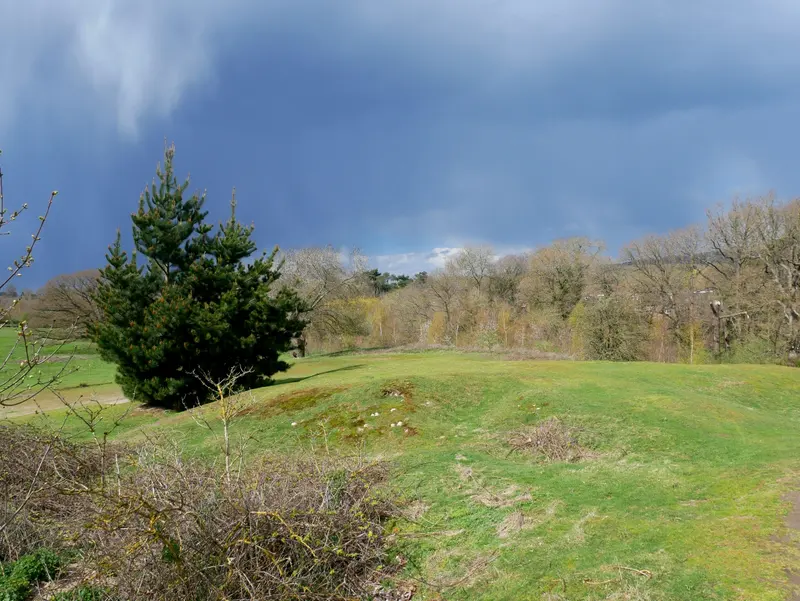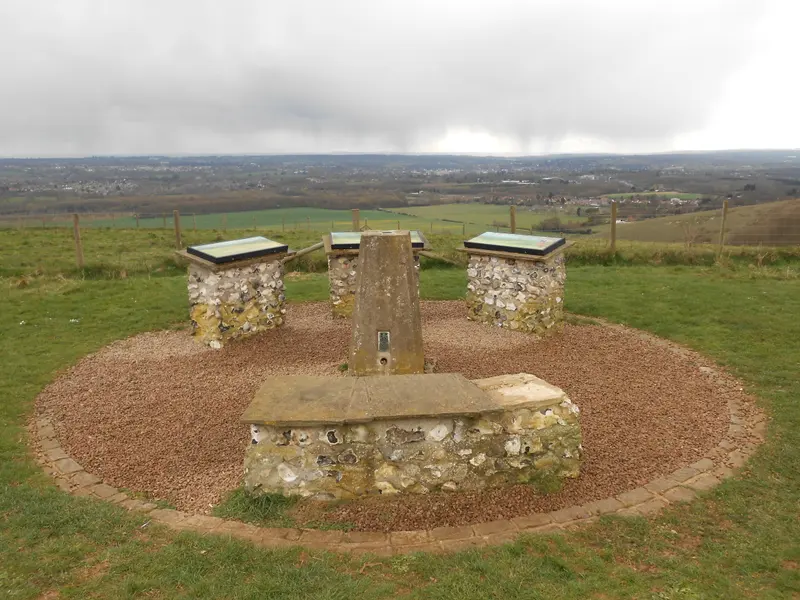
White Horse Wood is a useful place to consider when you want a countryside outing centred on looking rather than covering a long distance. Kent County Council describes the park as a place for panoramic views and access to the medieval remains of Thurnham Castle. A camera can give a short visit a satisfying purpose: record the setting, find one clear composition and finish with a smaller detail.
Plan the walking first and the photographs second. The presence of a viewpoint does not tell you whether the conditions, surfaces or available time suit your group. This guide brings together official planning resources and an original photography exercise. It is not a replacement for the park map or a claim that we have recently inspected the paths.
Choose the official route that suits you
The Kent Downs stile-free trail guide describes a short circuit of about 0.7 miles, or 1.1 kilometres, and a longer option of about 0.9 miles, or 1.4 kilometres, taking in the castle. Read the full route description rather than treating the distance as the whole story. Stops, gradients and ground conditions can make a short distance take longer than expected.
Stile-free is a specific feature, not a guarantee of suitability for every wheelchair, mobility aid or pushchair. The official guide advises assessing surfaces and weather conditions. If access is central to your plans, contact the operator with the details that matter to you rather than relying on a general label. Being able to turn back comfortably is a useful part of the plan.
Keep the current map available before you arrive, particularly if your phone connection might be unreliable. Decide whether the castle option is essential or optional. Agreeing that in advance makes it easier to adapt if the weather changes or somebody needs a shorter outing.
Check the practical details before setting off
Use Kent County Council's park page for the map and current visitor information. Check parking arrangements and any notices directly rather than carrying an old fee or closing time from a travel article. An early photographic start is only useful if the access arrangements support it.
Look at the forecast for the period when you expect to be outside, including wind and visibility. A wide view can disappear in poor visibility, but a close subject may still work if the conditions are otherwise suitable. Do not let the hope of a particular photograph override a sensible decision to shorten or postpone the outing.
Take less equipment than you would for a dedicated photography trip. A phone or one camera and lens is enough for the exercise below. Keeping hands free and the bag light makes it easier to move, consult the map and enjoy the place with other people. Add equipment only when you know what it will help you photograph.
Picture one: explain the setting
Begin with a view that shows how the land is arranged. Look for a foreground edge, a middle distance and a horizon, but do not force all three into the frame if the result feels cluttered. The purpose is to make the scene understandable. Someone who was not there should be able to follow your eye through the picture.
Try placing the horizon at two different heights. With more sky, the photograph may emphasise weather and openness; with less sky, the pattern of the land becomes more prominent. Compare the versions on the screen before moving on. The better choice is the one that supports the subject you actually noticed.
Inspect the corners as well as the centre. A bright patch or an awkward branch can pull attention away from the view. A small movement within the permitted path or viewing area may simplify the edges. If it does not, accept the limitation and try a tighter composition rather than seeking a precarious position.
Picture two: choose one relationship
The second photograph should be more selective. Look for a line crossing a field, a tree against a lighter background or a repeated shape that gives the eye somewhere to travel. Your aim is to explain one relationship clearly, rather than reduce the first photograph by cropping a little from every side.
Hold the camera steady and take time to check focus. On a phone, tapping the main subject can help establish where you want attention. If the sky is much brighter than the land, try adjusting exposure slightly and compare the result. A darker overall photograph is not automatically better; keep useful detail in the subject that matters.
Make only a few versions, changing one thing at a time. Move the main subject within the frame, alter the amount of sky or wait for a different patch of light. When every setting changes at once, it becomes harder to understand why one picture works and another does not.
Picture three: notice a smaller detail
Finish with something that rewards a closer look from an accessible position. It might be a texture, the meeting of vegetation and path, or the outline of a branch. A small subject gives the set a change of pace. It also encourages you to look at the place as more than a platform for a distant panorama.
Leave plants, stones and other features where they are. The exercise is to find a composition, not arrange the landscape. Avoid stepping into vegetation for a cleaner background. A subject that can only be photographed by disturbing its setting is an easy one to leave for another day.
Check whether the photograph needs a little surrounding space to explain its scale. A close texture can become almost abstract, which may be exactly what you want. If you prefer a more descriptive picture, include an edge or a neighbouring feature that makes the relationship easier to read.
If you include Thurnham Castle
Treat the ruins as a separate subject with their own context. A photograph of open countryside near the castle is not a photograph of the castle. Keep captions precise, particularly when you share pictures with someone who does not know the area. The hero image on this page is a credited White Horse Wood viewpoint photograph, not an image of the ruins.
Our Thurnham Castle photography guide discusses setting, structure and texture as three possible approaches. Follow the current site guidance and observe from permitted positions. There is no need to climb on remains or stage an adventurous-looking scene to communicate a sense of history.
If the castle extension would make the outing rushed, save it. A three-picture study of the wider landscape is already a complete small project. Returning with a different purpose can be more rewarding than trying to make one visit cover every possible subject.
Review the photographs as a set
At home, choose one photograph for each role: setting, relationship and detail. Remove near-duplicates and give each image an accurate caption. Notice which picture still interests you after the excitement of the outing has passed. That often reveals whether you prefer a descriptive view or a quieter, more abstract reading of the landscape.
For a wall, test the actual crop before choosing a frame. A successful wide photograph may lose its balance in a square. The Thurnham collection and our shape guide offer ways to compare those choices. Image credits and the distinction between reference photographs and generated concepts remain visible throughout the gallery.
A place for your wall.
Explore the collection, then choose a size and finish at your own pace.